Auxiliary (Basic ㊦ 100)
An auxiliary indicating the speaker’s conjecture which is not based on any particular information or evidence.
Equivalent: Probably
| (1) {V/Adjective い} informal | だろう | |
| {話す/話した} だろう | Someone will probably talk/probably talked | |
| {高い/高かった} だろう | Something is/was probably expensive | |
| (2) {Adjective な stem/ N} | {Ø/だった} だろう | |
| {静か/静かだった} だろう | Something is/was probably quiet | |
| {先生/先生だった} だろう | Someone is/was probably a teacher |
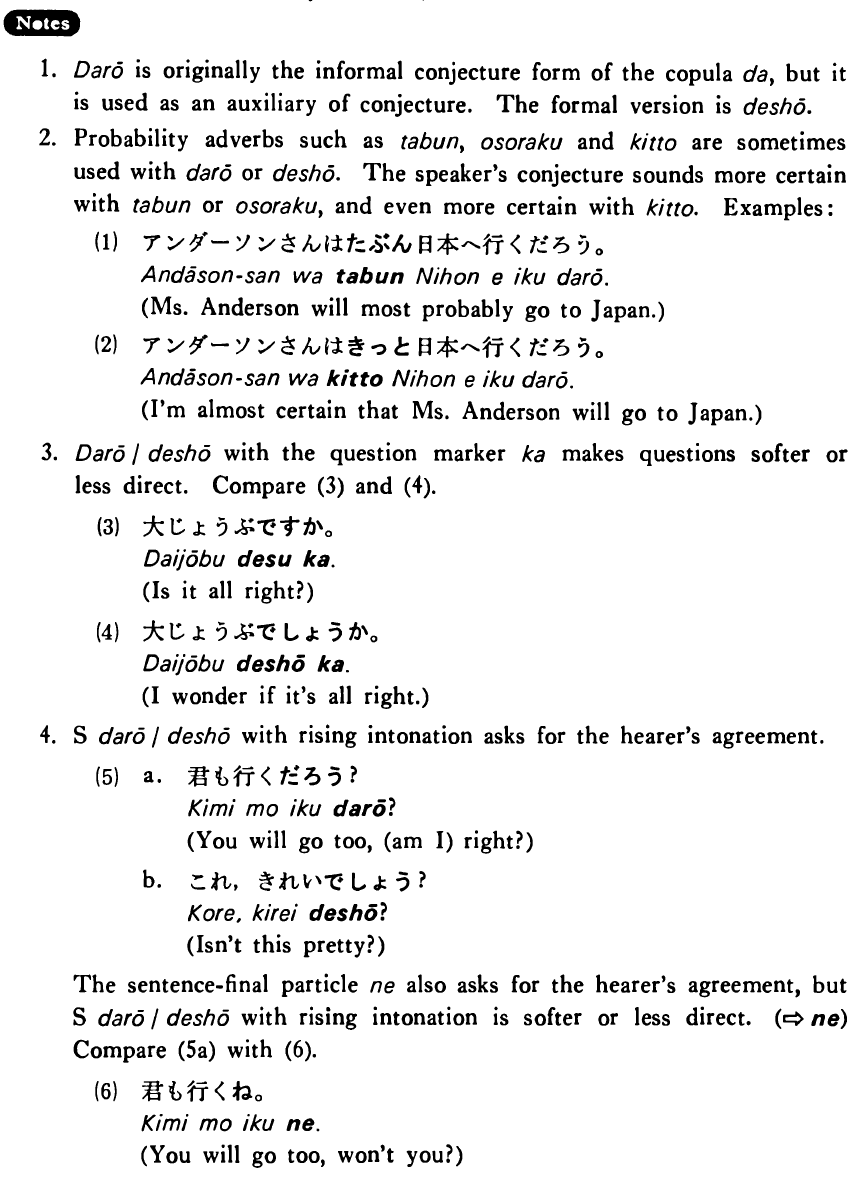
1. だろう is originally the informal conjecture form of the copula だ, but it is used as an auxiliary of conjecture. The formal version is でしょう.
2. Probability adverbs such as 多分, おそらく and きっと are sometimes used with だろう or でしょう. The speaker's conjecture sounds more certain with 多分 or おそらく, and even more certain with きっと. Examples:
3. だろう/でしょう with the question marker か makes questions softer or less direct. Compare (3) and (4).
4. Sentence だろう/でしょう with rising intonation asks for the hearers agreement.
The sentence-final particle ね also asks for the hearer's agreement, but Sentence だろう/でしょう with rising intonation is softer or less direct. (⇨ ね)
Compare (5a) with (6).